Nov 25, 2026 | My Blog
Recently I was accosted by a choice that once again tested my boundaries.
Over the years I’d said yes to things that took up so much of my time and energy that I had almost nothing left for myself and even less to build my own business. Although we did really good work and built a solid community, I was so busy with these unpaid volunteer duties that my own business suffered. The personal and financial cost of this was a big part of why I eventually had to completely rethink my business and my life.
It took me a long time and a lot of self-work to remove myself from a situation that wasn’t healthy for me. Not because of the situation itself, but because of what it meant to me, how it made me feel and the stories I was telling myself.
Looking back, it was easy for me to get so wrapped up in the work we were doing. It distracted me from asking myself the hard questions about who and what I was outside of the industry I’d spent more than 25 years in.
My confidence had been broken down over the course of a year and I was struggling with my own sense of worth. The work made me feel useful and gave me a sense of identity, belonging and security at a time when I needed it. But being so busy also distracted me from exploring why I needed it so much.
I’ve been weaning myself off for years and have had a lot of inner conflict during this time. I could no longer afford to give my full 100% as I used to, but I also struggled to walk away completely because the work was still important to me.
So I caught myself in this limbo trap. An open loop, as it were.
When this decision came at me (on a Saturday night no less), I couldn’t dodge the choice any more. Once again unpaid work but with a slightly different angle, I’d been quietly procrastinating about making a yes/no decision and hoping that, since I’d missed the deadline, it would just go away.
Alas not.
Part of what made this decision difficult was not knowing what my own workload would look like in the coming months.
If you’re lucky enough to have a couple of projects in the pipeline, what the heck will you do if they all come off at the same time? Do you have the capacity, not just in terms of time, but also in terms of the focus and energy each of these projects will require from you? And if you do, what will it cost you?
I’ve spent the last six years building my own business and I don’t want to find myself in a situation again where my unpaid work comes at the expense of what I’ve built. But things almost never go as planned and we have to adapt and adjust along the way.
So here I am, faced with a decision. I don’t have all the information and my strong habits of responding quickly and taking ownership are pushing at me.
A phone call with a loved one reminds me to get more information.
In my head I already have a number of hours I’d be willing to commit each month. I buy myself some more time, but get a quicker response than I thought. The number of hours they need from me is exactly the number I had in mind and once again the ball is in my court.
I force myself to sleep on it, but I know I’ve already made up my mind.
The next morning I test it anyway. I read through the emails and messages again to make sure I understand exactly what is going to be expected of me. I look for possible hidden scope creep and think back to similar situations, what happened then and what I’ve learnt about what works for me and what doesn’t.
I find myself spending my normally restful Sunday putting the requested information together as I realise I’ve already quietly said yes.
When I submit, I get a beautiful message back and I know that my help is appreciated. It remains to be seen if we can really make a difference. Over time we will see what the price of saying yes will be.
Later, another phone call with a loved one triggers me when I’m challenged for letting my boundaries soften.
Although I’m already feeling a little disappointed in myself for going back on a decision I’d sort of made earlier in the week, I hadn’t thought of it as dropping my boundaries. I feel like I couldn’t stick to my guns and the comment shocks me.
I feel defensive and realise that I can easily justify my decision, but that, in itself, isn’t really the point.
It makes me question whether, in that moment, I really know the difference between adjusting a boundary and compromising it.
The circumstances have changed, I’ve changed, but I also need to be honest with myself. I still find it a little difficult to say no to this particular person in this particular context.
I think part of the reason I’d been procrastinating about making this decision was that I was still afraid of getting sucked in completely again.
Interestingly, I wrote a blog a few years ago about reframing procrastination as a clue rather than a disaster. Perhaps I needed to pay a little more attention to my own procrastination and explore what it was trying to tell me.
Some boundaries are hard and need a definitive no.
Some boundaries are softer and allow for adjustment.
If the boundary is a hard no, the choice is more clear. It’s when things get fluffy that the choice is more difficult and deserves a bit more work. Both boundaries will constantly be tested and my job is to take a bit of time to reflect on exactly what I’m saying yes to, and then to be honest with myself about what I’m saying no to.
We put boundaries in place based on what we know at the time. As we take time out, reflect and learn from previous experiences, we develop our ability to make better decisions. Sometimes that means adjusting our boundaries a little. Not with abandon, but with deeper understanding and with open eyes to the risks and the red flags.
Although I’m still a little afraid of getting sucked in again, I know I can contribute without giving so much of myself that I have nothing left for myself or my business.
For me, this means staying within the hours I’ve committed to each month and sticking to some of the rules I’ve already put in place for myself. I can plan around online meetings and honour the commitments I’ve made, but when things change at the last minute, I look at what I already have in my diary and give myself permission to say no if accommodating those changes comes at too great a cost to me.
I need to remember that just because I’ve said yes to the work doesn’t mean I have to say yes to everything that comes with it.
How much time and energy I have left for myself and my business will be my measure of whether I’m managing to stay balanced.
And if I find that I’m not, I’ll need to revisit my decision.
I think part of the work for me now is learning to trust myself a little more. To stick to my guns where I need to, but also to allow myself some flexibility based on what I’ve learnt.
Perhaps the next time you find yourself questioning one of your own boundaries, take a bit of time to reflect on why you put it in place in the first place, what has changed since then and how you will know whether adjusting it is still serving you.
Aug 26, 2026 | My Blog
Normally these blogs start when something happens and I have a flash of recognition, a moment where I suddenly realise something I hadn’t thought about in quite that way before. Then I start writing and, while I write, I take more time to reflect and somehow the blog reveals itself. Sometimes I know where it is going to end and sometimes… no clue!
This is one of those where I don’t, because yesterday I had a moment of real panic and anxiety about how our world is changing with AI.
For a long time we’ve been hearing how AI is going to take our jobs and I’ve been firmly in the camp that AI is a tool and that we need to learn how to use it responsibly. I’ve made it my business to learn how to use it in my own world and, as a solo entrepreneur, it has been an incredible resource.
I use it to help me make sense of my thoughts, explore ideas and generally sort through some of the chaos and fluff that seems to be part of running a business on your own. Sometimes I use it as a thinking partner and sometimes I just dump a whole lot of thoughts into it and ask it to help me figure out what I’m actually trying to say.
A bit like this blog, actually. Aaah, the irony!
As a solo entrepreneur, that kind of help would often have been out of reach financially, so suddenly having access to a tool that can help me make sense of a much bigger world has been incredibly useful.
I won’t deny that there has also been a bit of a sense of being a pioneer, experimenting with it and helping people around me explore how AI could change our worlds.
At the same time, over the last few weeks I’ve started picking up another theme. I’m hearing from people who are watching normal, untrained people use AI to do work they might previously have been paid to do. I’m hearing people across different industries beginning to realise that their work is changing and their income is being affected, while trying their best to prepare for changes nobody really knows how to predict.
I knew all of this, or at least I thought I did, but yesterday I felt its teeth.
I realised that perhaps it isn’t as simple as AI taking our jobs. AI is already being used to take pieces of the jobs that give people their income.
I’ve heard versions of this before, but I don’t think I really understood it until I looked at what I was doing myself. Without really thinking about it, I was already using AI to do things I might previously have needed someone else to help me with.
To be fair, I probably couldn’t have afforded those services anyway, but isn’t that exactly how it starts? Small changes happening all around us without us really noticing them, until eventually we look up and realise that the way we work has changed.
Suddenly I understood the panic and uncertainty I’m hearing in a way I hadn’t before. For all the reading, experimenting and learning I’ve been doing, I still don’t know exactly how this is going to affect my work, the people I love or the world we live in.
When I woke up this morning, I realised that this feeling was incredibly familiar.
It was the same fear I felt during COVID: the fear of understanding that my world was changing around me, that there was nothing I could do to stop that change and that burning question:
How do I prepare when I don’t even know what I’m preparing for?!?
I had spent 25 years building my life in the tourism industry. My identity, livelihood, lifestyle, friendships and a huge part of how I understood myself were all wrapped up in it, and then suddenly the world stopped travelling.
My worldview was shattered.
Perhaps one of the hardest parts wasn’t only what we lost in the blink of an eye, but that nobody could tell us what would happen next. There was no way of knowing when tourism would start again, which businesses would survive, whether our jobs would still exist or how long any of it was going to last.
Once I recognised that feeling yesterday, I started thinking about what actually got me through it and, with hindsight, it certainly wasn’t that I didn’t panic. I did. We all did, some probably more than others.
During the first few days of lockdown my Mom said something that has stayed with me ever since:
“Now you are really going to see who people truly are.”
She was right.
Some people disappeared into their own spaces, some carried on as if nothing had changed, some became angry, frightened or overwhelmed, while others quietly stepped up and did whatever they could. Some helped in small ways like fetching rubbish, bringing food or checking in on people, while others helped us make sense of all the noise and tried to solve problems none of us had ever faced before.
We learnt who we could trust, but we also learnt that nobody really knew what was going to happen. There were things we could plan for and work towards, but there was an equally big, if not bigger, part that we simply had to wait and see.
I remember people saying, “We are building this plane while we are flying it,” and strangely that helped me because I understood that we were making up the game while we were living it. There wasn’t an instruction manual I had somehow missed; we were all trying to work it out as we went along.
Realising that I couldn’t just sit back and wait, and that I needed to do something, helped me work through the crisis of who and what I was without tourism. It gave me the opportunity to explore things I might never have explored otherwise and, if I’m honest with myself, I wasn’t in a great place before COVID anyway.
That time gave me the courage to look hard at myself and rethink a lot of things. I can honestly say that I probably would have been too scared to step away from tourism completely if it hadn’t first been ripped away from me.
I didn’t really have a choice. Change was going to happen anyway.
Maybe that is the part I needed to remember yesterday.
As the world seems to be going faster, I think perhaps we should be slowing down and dealing with what is actually in front of us.
We can pay attention to what is changing, learn what we can and think about what we actually want our lives to look like. Most importantly, if the world as we know it is going to change, we can work on making ourselves fit enough to change with it, but on our own terms.
Maybe that is what mental fitness looks like right now: not knowing exactly what is going to happen, but trusting that we can work it out when it does.
Because if you’re reading this, you’ve survived 100% of the things that have happened to you so far.
That doesn’t mean they didn’t hurt, change you or leave scars, and it doesn’t mean you knew what you were doing while you were going through them. Somehow, though, you found your way through.
Maybe COVID was our crash course in learning that we don’t need to know exactly what is coming in order to find our way through it.
AI is here and things are going to change. I don’t know exactly what that will look like, and I’m still a little scared by that.
For now, I keep coming back to the words of Maya Angelou:
“Do the best you can until you know better. Then when you know better, do better.”
Jun 20, 2026 | My Blog
The other morning I was driving out of our driveway.
As the car levelled out after rolling down the hill, I automatically pressed the petrol to move us forward. Distracted by the people in the car and my own thoughts, it took me a minute to realise that something wasn’t quite right.
The engine was revving, but we weren’t really moving forward. In fact, we were slowing down.
The moment my brain recognised that something was wrong, it snapped out of muscle memory and back into being present.
In a split second I realised I hadn’t put the car in gear at all.
We laughed and agreed that no matter how much petrol you give, if you’re not in gear, you aren’t going anywhere.
But afterwards, the moment stayed with me.
Because in that moment I was doing something I’ve done hundreds of times before. Something so familiar that I didn’t really need to think about it anymore. Except this time, I’d missed a step without even realising it.
It made me wonder how often we move through life like that.
Doing what we’ve always done. Following familiar patterns and routines without really being present in them. Running on autopilot until the warning signs become too obvious to ignore; the revs picking up while the movement slows down.
That moment when you realise that more effort isn’t actually moving you forward.
What struck me most was how quickly things shifted once I became aware of what was really happening. Not with panic or self-blame, but simply by becoming present enough to notice.
Something isn’t right.
Pause for a moment.
Look properly.
Adjust.
Then keep going.
It reminded me how important it is to move from awareness, to acceptance, to action when things go wrong. Not to stay stuck in frustration or embarrassment over missing the step, but to recognise what’s happening and respond to it.
And maybe that’s the real work sometimes. Learning to notice sooner.
To catch ourselves before we keep pouring energy into something that isn’t working. Before we keep revving harder while slowly losing momentum.
And perhaps also to trust ourselves a little more.
Because even though I slipped into autopilot and missed something obvious, once I became present enough to see what was really going on, I already knew how to fix it.
Mar 6, 2026 | My Blog
Recently a new client told me something that totally triggered me.
They had approached their boss about doing our coaching sessions during the workday. The response was quick: first they were told that they didn’t need coaching, and second that the company couldn’t make space for it during work hours.
The more I thought about it, the crosser I got.
Part of me recognises that this is exactly the kind of mindset I don’t want to be working with anyway. But another part of me wants to punch them in the nose and show them what can be done. I realise that’s not exactly healthy motivation, but it’s how I feel.
A part of me wants to rant about the narrow-mindedness of it all. The unwillingness to support someone who is actively trying to grow and develop themselves. Someone who is willing to invest their own time and money to do the work.
Honestly, it breaks my brain.
But the more I sat with it, the more I realised something else.
This story isn’t really about the boss or the company.
It’s about the people who choose themselves anyway.
Over the years I’ve had the privilege of working with people who decided that something in their lives needed to change. Not celebrities. Not big-shot executives. Just normal, everyday people who reached a point where they realised they couldn’t keep doing things the same way.
People who felt the discomfort and didn’t run from it.
People who were willing to sit with that discomfort long enough to start asking questions. To look honestly at where they were. To admit that something needed to shift.
And then they started doing the work.
Some were able to do their sessions during work hours.
Others sat in their cars in the parking lot before work.
Some showed up after long days.
Others squeezed the work into lunch breaks or weekends.
Not because it was convenient.
But because they had decided that their own growth mattered.
They kept showing up even when the path wasn’t clear.
And slowly, things began to shift.
New jobs.
Mindsets shifted.
Relationships improved.
Confidence grew.
Not overnight.
Just one decision at a time.
One uncomfortable conversation at a time.
One small shift in thinking at a time.
These people are my heroes.
Choosing yourself in a world that uses most things as disposable is, to me, the highest act of self-love and self-respect.
Choosing growth when it would be simpler to stay comfortable takes courage.
And choosing to keep going, even when progress feels slow or uncertain, takes real commitment.
So this story isn’t really about the boss who said no.
It’s about the people who say yes to themselves anyway.
The ones who keep learning.
Who keep growing.
Who keep showing up for their own lives.
Those are the people who quietly change the world.
Starting with themselves.
Feb 14, 2026 | My Blog
A few weeks ago, I watched an interview where they were talking about internet privacy.
The expert said something that stopped me mid-thought:
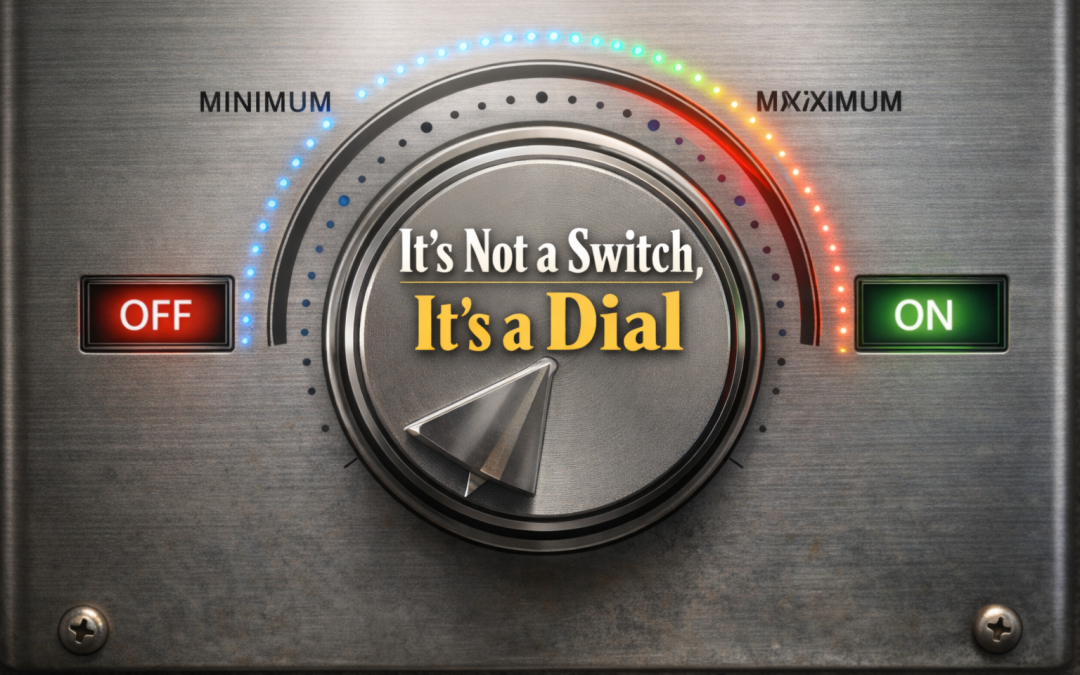
“People think about internet privacy as a switch. It’s not. It’s a dial. You get to choose how much or how little you expose.”
It hit me right between the eyes.
Because the more I sat with it, the more I realised this wasn’t just true about internet privacy. It’s true about so many areas of our lives.
We often treat things like switches. All or nothing. On or off. Fully in or completely out. But life rarely works that way. Most of the time, it’s not a switch at all… it’s a dial.
And a dial means choice. It means nuance. It means I get to decide how much intensity, energy, time, or emotional exposure I allow.
I did a lot of volunteer work. It’s not life-and-death work like saving people or wildlife, but it is work meant to help people build better lives. Work with good intentions. Work that matters.
Over time, though, I let it take over completely.
It cost me my mental health.
It cost me my physical health.
And if I’m really honest, it cost me a business.
Not because the work itself was wrong, but because I didn’t understand the cost of not seeing clearly. I hadn’t created boundaries. I was looking for validation and affirmation from people who had different agendas and their own things going on. And I kept telling myself it was for the greater good.
Until it wasn’t.
Once I could see what was really happening what, in fact, I was allowing to happen, I started disengaging. Emotionally at first. Then practically. I worked hard at sticking to my no’s and at reshaping my boundaries. I had to shift my mindset and my expectations of myself.
That wasn’t easy.
Walking away didn’t feel like me. But staying half-in, half-out this not fully committed, yet constantly drained, that wasn’t good for me either. That limbo space was doing real damage.
As I struggled with this, I started paying closer attention to the people around me. And what I noticed was that I wasn’t alone. So many of us are wrestling with balance.
Balancing personal and professional lives.
Balancing unpaid work with the work that actually pays the bills.
Balancing conscience to what seems to be the right thing with family time.
Balancing personal growth and awareness in a world that just keeps asking for more.
So I started asking myself a different set of questions.
If I say yes to this, what am I saying no to?
And if I say no to this, what am I saying yes to?
Looking back now, I can see that I wasn’t just pulling away, I was testing boundaries. I was creating principles. I was slowly figuring out my own rules of engagement. I was learning what level of intensity was healthy, what needed adjusting, and what I needed to step away from completely.
I was learning how to use the dial.
I don’t always get it right. I’m still learning what works and what doesn’t. Life keeps putting me into new, interesting, and sometimes challenging situations. That’s part of the deal.
But now I can see the guardrails more clearly. And I know they’re there to protect me, not to limit me.
So I try.
I mess up.
I learn.
I adjust.
And through all of it, I remind myself that I’m in charge of my own dial of how much I give, where I show up fully, and where I consciously pull back.
It’s still a work in progress. But this small shift, from switch to dial, has made it easier to breathe. The work now is simply to keep adjusting. Gently, intentionally, and in ways that are simple enough to repeat when life inevitably throws the next curveball.
I’d like to invite you to sit with this.
To explore what in your life is a dial.
And to be honest about whether there is something that is actually a switch. In truth, some things do need a clear boundary.
Be aware.
Take your time.
Test what works better for you.
It’s a journey.
And you are in charge of the dial.
Recent Comments